Best Vacuum for Cat Litter and Pet Hair: Stick, Robot, or Handheld
Stick, robot, or handheld for litter granules and pet hair? A desk-research comparison of what actually works, plus the mats that stop tracking.
ViralKittyTV Editorial Team
Editorial Team ·
📖 Table of Contents
Affiliate Disclosure: As an Amazon Associate, we earn from qualifying purchases. This comes at no extra cost to you. We do not run a test fleet; recommendations follow desk research, not paid placement. See How We Make Money.
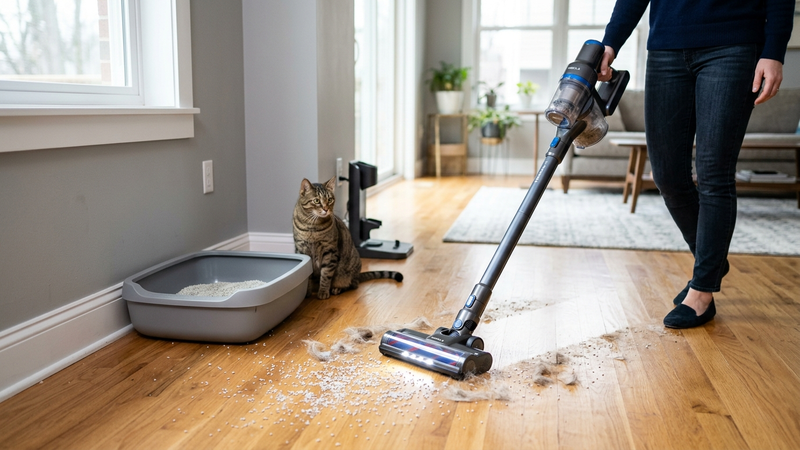
Litter granules and pet hair are a two-part problem, and the vacuum is only the second part. The first part happens at the box: which substrate you use changes how far the mess travels, which is why the brand-by-brand breakdown lives in our litter comparison and the clay vs crystal vs natural chooser in the litter type comparison. This page is about the machine that cleans up whatever gets past the box — the granules wedged into hardwood seams, the fur drift under the sofa, the trail from the box to the food bowl.
This is a research-based guide from the ViralKittyTV editorial desk, not a hands-on test. About already says we do not run an in-house lab or a test fleet. We compared manufacturer spec sheets, published reviews, and the complaints that repeat in verified owner reviews — granules rattling around the bin, hair wrapping the brushroll, dust clouds at emptying. We did not push ten vacuums across the same litter-scattered floor, and we did not meter suction with a gauge. If the cat has stopped using a clean box, that is a behavior question, not a vacuum question — start with litter box problems solved before you spend money on hardware.
Before you click: listing checks Amazon blurbs skip
Vacuum listings reuse “pet turbo,” “self-cleaning,” and “powerful suction” across wildly different machines. Read past the blurb.
- Hard-floor performance is a separate claim from carpet deep-clean scores. Most headline suction numbers are carpet-mode figures. Litter lives on hard floors, where you want a dedicated hard-floor mode or a soft roller. If the listing only brags about carpet, assume hard floors were an afterthought.
- Anti-tangle brushroll design, named specifically. “Pet hair” marketing without a stated hair-cutting or zero-wrap mechanism means hair wraps the roller and you cut it off weekly with scissors. Look for the mechanism in the spec bullets, not the lifestyle photos.
- Bin volume and the emptying mechanism. Litter is heavy. A 0.1–0.3 L dustbin fills in one hallway and every emptying cycle is a decision point: door-flap empties that trap granules, bagged systems, or the dump-it-in-the-sink mistake that clogs plumbing (do not).
- Sealed filtration if clay dust bothers anyone in the house. Washable, sealed HEPA-class filters keep fines inside the machine. Washable matters — litter dust clogs filters faster than household dust.
- Battery swaps, not just runtime claims. A stick vacuum that dies at 20 minutes with a sealed battery is a disposable appliance. Screw-in, replaceable batteries and spare-pack availability extend the useful life by years.
- New, not refurb, unless the seller says refurb. Vacuum motors and battery packs degrade; “open box” deals on high-wear machines are how you inherit somebody else’s dead battery.
What actually handles litter granules
Granules are dense, low-profile, and round-ish — they skitter away from wimpy airflow instead of lifting. Three spec traits separate machines that pick litter up from machines that bat it around:
- Direct suction at the floor plate. On hard floors, the cleaning head needs unobstructed airflow close to the surface. Soft roller heads (fabric-wrapped rollers) grab granules and fine dust simultaneously; turbine carpet heads with tall bristles can flick granules sideways on bare floors.
- Enough continuous airflow to lift weight. Within a single brand, higher-tier models move more air through the same head geometry. Across brands, the numbers are not comparable — a Dyson “air watt” and a no-name “PA” rating measure different things. Owner reviews on granule pickup are the honest cross-brand signal.
- A bin that empties without a dust cloud. Clay fines and silica dust go airborne at emptying. Door-flap and binned emptying designs that keep the dust contained get repeat praise in owner reviews; twist-off cyclones that puff fines into your face get repeat complaints.
Hair is the second workload. Long cat hair wraps a plain brushroll in one session. Anti-tangle engineering — ridged rollers, comb strippers, conical bristles — is what keeps a pet household vacuum from becoming a weekly scissors chore.
Stick vs robot vs handheld for litter
Cordless stick vacuums are the default answer for litter households. You grab them one-handed for the daily box-to-bowl trail, they live in a wall dock, and the current V-class generation has the hard-floor heads and anti-tangle rollers the task needs. The trade is price and battery aging — which is why the budget tier below exists.
Robot vacuums are maintenance, not a solution. On hard floors a robot sweeps the tracked-out granules you missed yesterday, and daily scheduled runs genuinely reduce fur drift. But robot dustbins are tiny — a multi-cat litter trail can fill one mid-run — and the box-side scatter zone usually needs a targeted stick pass anyway. Some cats also treat a robot as a predator and relocate the whole problem. Robots earn their keep in multi-pet, large-hard-floor homes; they do not replace the handheld grab.
Handhelds own the hot spots. Stairs, the car, the crack beside the box, the rug under the feeding station. A cheap pet-hair handheld with a motorized mini-brush handles the daily worst square meter. The trade: tiny bins, short runtimes, and most are useless on whole rooms.
Corded uprights still win on raw value if outlets and storage space are not a problem — more sustained airflow per dollar, no battery to age out, and bags that hold a month of litter. The trade is the grab-and-go friction that makes daily cleanup actually happen.
The Dyson V-series class: the known benchmark
The Dyson V-series is the machine class everyone else prices against, and the reason shows up in the spec details rather than the logo: consistent hard-floor head engineering, washable sealed filters, and on the Detect-tier models a projected light that reveals fine dust and granules on dark floors plus a piezo particle sensor (a maker claim — we did not test particle counting) that reports what the machine picked up. Newer tiers use screw-in swappable batteries, which directly addresses the battery-aging weakness of older cordless sticks.
The practical tiers:
- V15 Detect-class — the flagship tier with the laser/sensor head. Typically listed in the 650–750 dollar band in our latest desk pass. Dyson V15 Detect on Amazon →
- V12 Detect Slim-class — most of the same hard-floor engineering in a lighter, cheaper package; the tier most litter households actually need. Usually around 450–550 dollars. Dyson V12 Detect Slim on Amazon →
- Legacy V8-class — older head, no detection features, smaller bin, but sealed filtration and a proven motor at a third of flagship money. Often 350–420 dollars, and a common refurb tier — check seller grading on batteries. Dyson V8 on Amazon →
These bands are from our late-2026 listing scans, not live prices — check the current number before deciding anything.
Budget alternatives that still clear the litter bar
The Dyson class is the benchmark, not the requirement. Three cheaper classes clear the litter-and-hair bar according to owner-review patterns:
- Shark anti-hair-wrap class (roughly 250–400 dollars) — the Anti Hair Wrap Plus / Stratos tier. The stated hair-cutting mechanism addresses the brushroll-wrap problem directly, and hard-floor modes on recent models are competitive. Shark anti hair wrap vacuums on Amazon →
- Tineco Pure One class (roughly 200–350 dollars) — app-driven suction that ramps when the floor is dirtier (maker framing), washable filters, and quiet hard-floor heads that suit the daily litter trail. Tineco Pure One on Amazon →
- Bissell Pet Hair Eraser-class handhelds (roughly 40–90 dollars) — the hot-spot machine. Not a floor solution, but the cheapest possible answer for the square meter beside the box. Bissell pet hair eraser handheld on Amazon →
The cheaper half of the fix: litter mats
A vacuum cleans what escaped. A trapping mat stops the escape. Dual-layer honeycomb mats catch granules at the box exit before they reach the floor proper — the pattern in owner reviews is consistent enough that a 20–35 dollar mat reduces the daily vacuum pass more than any vacuum upgrade does.
Pair the mat with the substrate and box that track less in the first place: the litter type comparison covers how clay, crystal, and plant litters differ in scatter, and self-cleaning litter boxes cover the hardware side of containment. Mat plus box placement plus a weekly stick pass is the whole system; the vacuum is the last third of it.
When to skip this buy
- Wall-to-wall carpet and a big storage closet. A corded bagged upright costs less, never needs a battery, and outlives two cordless sticks. The grab-and-go convenience is what you are paying for with a Dyson-class machine.
- You already own a working vacuum. Buy the 25 dollar mat and a 60 dollar handheld before assuming you need a 700 dollar flagship. Fix the escape route first.
- You expect the robot to do everything. A robot reduces frequency; it does not handle the box-side scatter zone, its bin is too small for multi-cat litter, and a box-adjacent accident can turn into a smearing event. Robots are a supplement here, not the answer.
- The real problem is litter box avoidance. No vacuum fixes a cat that stopped using the box. Litter box problems solved is the right page, and a vet visit may be the right first step.
Research snapshot of typical U.S. listing bands
Desk-checked listing scans from our late-2026 pass, quoted as ranges because list prices move weekly and we do not track them live:
| Class | Typical band (USD) |
|---|---|
| Dyson V15 Detect-class flagship | 650–750 |
| Dyson V12-class slim | 450–550 |
| Dyson V8-class legacy | 350–420 |
| Shark anti-hair-wrap tier | 250–400 |
| Tineco Pure One tier | 200–350 |
| Pet-hair handheld | 40–90 |
| Honeycomb trapping mat | 15–35 |
Treat every number above as a sanity check, not a quote. Start-here tables for the rest of the cat household are on the guides hub.
ViralKittyTV Editorial Team
Editorial Team
We're a small, independent group of cat enthusiasts who write together under one byline. Every recommendation is backed by specification analysis, ingredient analysis against AAFCO standards, published veterinary guidelines, and aggregated feedback from real cat owners in communities like r/cats, r/CatAdvice, and breed-specific forums. No brand pays for placement here, and no ranking has ever been for sale.
Related reading
Same cluster on this site — live guides only.
Dog Tips, Deals & Gear Guides
Expert buying guides, breed-specific product picks, and honest gear reviews. Plus our free New Puppy Checklist for subscribers.
📬 No spam, ever. Unsubscribe anytime. · Get the free puppy checklist